Every morning, before my laptop even gets a “good morning”, I’ve already finished a bowl of ragi koozh — the fermented finger millet porridge that’s been feeding three generations of my Tamil family. My colleagues still look at my steel bottle like I’m carrying nuclear waste. I haven’t stopped.
Ragi flour + water + overnight ferment = gut health for ₹10/day.
That’s the equation. No fancy blender. No ₹800 acai bowl. Just grandma engineering that works better than half the “wellness” aisle at your nearest supermarket.
Let’s talk about why this humble Tamil porridge deserves a permanent spot in your breakfast rotation — and why I’ve been carrying it to office since before “millet” was a government hashtag.
In This Post
- What Is Ragi Koozh? (The OG Probiotic)
- My Personal Journey — From School Tiffin to Office Desk
- How to Make Ragi Koozh (Step-by-Step Recipe)
- Benefits of Ragi Koozh — The Numbers Don’t Lie
- Frequently Asked Questions (8 Q&As)
- The 7-Day Ragi Koozh Challenge
- Conclusion — Your Grandmother Was Right
What Is Ragi Koozh? (The OG Probiotic)
Ragi koozh (also called ragi kanji, or கூழ் in Tamil) = fermented porridge made from finger millet flour + water + salt.
That’s it. Three ingredients. Zero Instagram-worthy presentation.
In Tamil Nadu farming households, this wasn’t a “superfood trend” — it was just what you ate before heading to the fields, and what you came back to at night. My Paati’s generation didn’t call it “functional food.” They just called it food.
Here’s why ragi koozh deserves your attention in 2026:
- Lifestyle diseases are exploding — diabetes + gut issues are more common in urban Indian millennials than in our parents’ generation. Fancy packaging ≠ healthy.
- Fermented foods are trending globally — kimchi, kombucha, kefir. Meanwhile, ragi koozh has been doing the same magic in Tamil kitchens for generations. For free.
- Processed-breakfast fatigue is real. Oats → hungry by 10am. Cereal → sugar crash by 11am. Maggi → let’s not even talk about it.
- Naturally gluten-free — useful if you’re millet-curious or managing gluten sensitivity.
- Costs almost nothing. One kilo of ragi flour = ₹60-100. Lasts 2-3 weeks. That’s under ₹10/day. Your protein bar is crying.
My Amma still makes this every single week. My father and I still eat it for breakfast. And somehow, despite oat milk lattes and quinoa bowls taking over Instagram, this humble fermented porridge has quietly stayed relevant the whole time.
Because things that actually work don’t need a marketing team.
My Personal Journey — From School Tiffin to Office Desk
I didn’t “discover” ragi koozh on a wellness podcast. It discovered me, at the breakfast table, before I even understood what fermentation meant.
Growing up: My Amma has made ragi koozh almost every week for as long as I can remember — school days, college days, and now, my marketing-professional-who-writes-blogs-at-midnight days. It was never a “diet food.” It was just Tuesday.
The part where I actually tested it like a nerd:
A few years into my corporate job, deadlines got brutal. I fell into the classic desk-job trap:
Skip breakfast → samosa at 11am → crash by 3pm → survival chai → repeat.
My colleague Ramesh once looked at my 11am samosa pile and said, “Bro, you’re eating like a man who’s given up on his arteries.”
He wasn’t wrong.
So I went back to what I grew up on. But this time, I tracked it like an experiment.
Week 1: Carried ragi koozh to office in a steel bottle. My teammate Priya looked at it and said, “Is that cement?” It wasn’t. It was breakfast. And it kept me full until lunch. Properly full. Not “I’ll just have one biscuit” full.
Week 2: The 11am snack run disappeared. That’s roughly ₹500-600/month I wasn’t spending on samosas and vada pav. Samosa addiction → savings account.
Week 4: The 3pm energy crash — the one I’d normalized as “just how office life works” — had mostly vanished. Third coffee? Not needed. Energy at 5pm? Still there.

The best part? My team started noticing. Someone would see the steel bottle and go, “Wait, you’re STILL eating that?” — half-mocking, half-jealous that I wasn’t crashing at 3pm like the rest of them.
A few of them have since asked me for the recipe.
Full circle moment for a dish my Paati’s generation ate because it was all they had.
I still eat ragi koozh several times a week. More out of habit and love than discipline. It’s the one food that’s followed me from school tiffin box → college hostel → office desk — and it’s probably the most consistent thing about my entire diet.
More reliable than my Wi-Fi, honestly.
How to Make Ragi Koozh (Step-by-Step Recipe)
Making ragi koozh is almost embarrassingly simple. The real “technique” is patience — fermentation does the work while you sleep.
Total effort = 15 minutes. Total cost = under ₹10. Total excuses = zero.
What You’ll Need
- Ragi (finger millet) flour — 1 cup
- Water — 3-4 cups (divided)
- Salt — to taste
- Wide-mouthed vessel or earthen pot for fermenting
Step-by-Step Method
- Mix the batter. Combine 1 cup ragi flour + 2 cups water + pinch of salt. Stir until smooth, no lumps. Lumps = your mortal enemy here.
- Ferment overnight. Cover the bowl. Leave at room temperature for 8-10 hours. It’ll turn slightly tangy — that’s fermentation working, not spoilage. Don’t panic.
- Boil the water. Next morning: bring 1.5-2 cups of water to a rolling boil in a thick-bottomed pot.
- Add the fermented mixture. Slowly pour the batter into boiling water while stirring continuously. This step = the difference between smooth koozh and lumpy cement.
- Cook and stir. Medium-low heat. 6-8 minutes. Keep stirring until it thickens to a semi-solid porridge.
- Cool and serve. Eat semi-solid with sides, or thin it with water/buttermilk for a cooling summer drink.

Pro Tips
- Earthen pot for fermenting = slightly better tang + texture than steel. Paati-approved.
- Keep stirring constantly once batter hits boiling water. Walking away for 1 minute = how lumps are born.
- Make a bigger batch → refrigerate for 2-3 days. Reheats or dilutes perfectly.
Common Mistakes (Don’t Be This Person)
- Under-fermenting: Less than 6-8 hours = no tang, no magic.
- Batter into not-fully-boiling water: This is the #1 reason for the lumpy mess that makes people say “ragi koozh is gross.” No, YOUR technique was gross.
- Over-salting: Add salt gradually. You can always add more. You can’t un-salt.
- Not stirring enough: Ragi thickens FAST. Leave it alone = burnt bottom, ruined pot, angry Amma.
What to Pair It With
This is where ragi koozh really levels up — the sides make it a full meal:
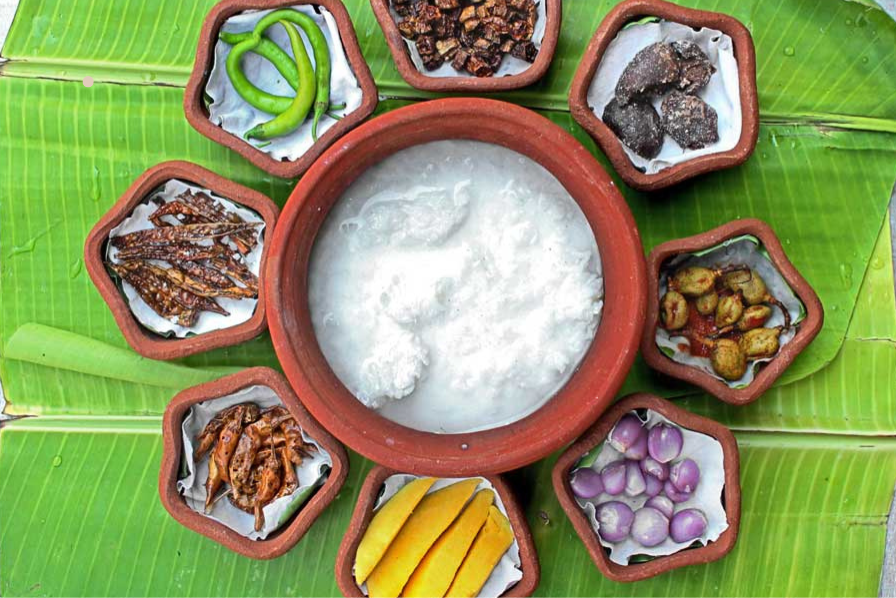
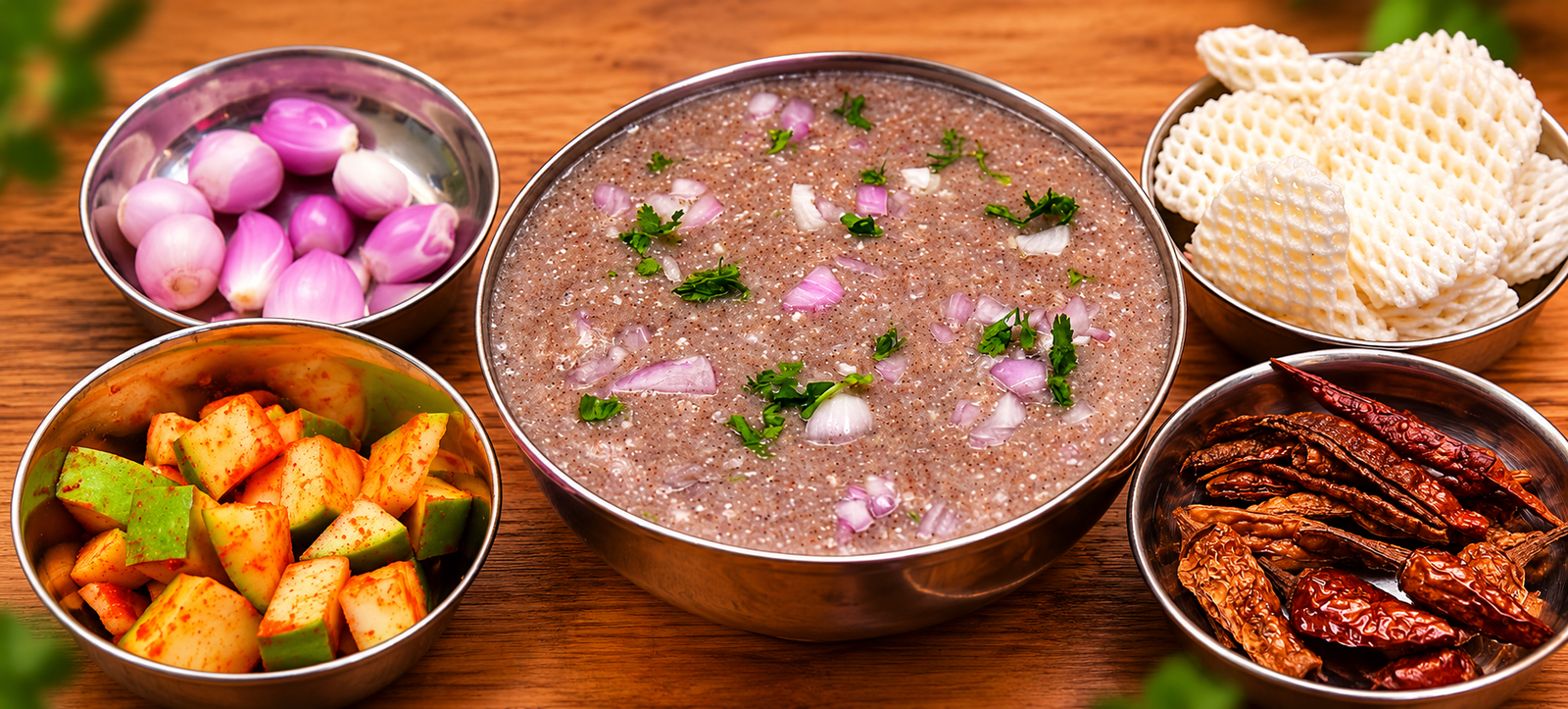
- Mango pickle (pulled, with chili) — crushed raw mango + green chilies + mustard tempering. Non-negotiable in my house. My Amma would disown me if I skipped this.
- Fried green chilies — slit, lightly fried, pinch of salt. Simple. Devastating.
- Small raw onion — crunchy, sharp, and somehow exactly what mild koozh needs.
- Kara kuzhambu or chicken curry — if you want it as a full lunch/dinner, pair thick koozh with a spicy curry. Comfort food level = 10/10.
Benefits of Ragi Koozh — The Numbers Don’t Lie
Ragi has been doing nutritional heavy-lifting long before “millets” became a government awareness campaign.
Here’s what the fermentation + the grain bring to the table.
Immediate Benefits (Same Day)
- Cooling effect on the body — traditionally eaten mornings or as a summer cooler (thin it with buttermilk = Tamil AC)
- Sustained fullness — high fiber = digests slower than cereal. You’re not hungry again in 1 hour.
- Light on the stomach — fermentation pre-digests starches. That’s why it’s traditionally given to people recovering from illness.
Long-Term Benefits
| Benefit | What It Means | Why It Matters |
|---|---|---|
| Calcium powerhouse | 300-350mg per 100g | Highest among all grains. Average Indian diet = calcium-deficient. |
| Naturally gluten-free | Zero gluten | Great for gluten sensitivity or reducing refined wheat. |
| Low glycemic index | Slower glucose release | Better blood sugar control than rice or maida. |
| Gut health (fermentation) | Beneficial bacteria | Same principle as curd/idli batter — probiotics for ₹10. |
| Weight-friendly | High fiber, low fat | Genuinely filling = less overeating later. |
Quick math:
Ragi koozh breakfast = ₹10/day = ₹300/month.
Your oat milk smoothie bowl = ₹250/serving = ₹7,500/month.
Savings per year = ₹86,400. That’s a weekend trip to Pondicherry. You’re welcome.
None of this makes ragi koozh a miracle cure. It’s a humble, fiber-rich, fermented porridge that’s been quietly doing its job in Tamil kitchens for generations.
Sometimes the “biohack” = what your Paati was already making.
Frequently Asked Questions
Q1: What’s the difference between ragi koozh, ragi malt, and ragi dosa?
Same flour. Completely different vibes.
Ragi koozh = fermented, cooked porridge. Thicker, tangier, eaten with sides like mango pickle or curry. The full meal deal.
Ragi malt = thinner, usually unfermented, sometimes sweetened with jaggery + milk. More “quick energy drink” than a proper meal. My colleague Karthik swears by this for his gym days, but he’s also the guy who puts protein powder in filter coffee, so take his advice accordingly.
Ragi dosa = thin batter cooked on a tawa. No long fermentation. Closer to regular dosa.
For gut health? Koozh wins. For speed? Malt or dosa.
Q2: Is ragi koozh good for weight loss?
Short answer: yes, with caveats.
High fiber + low fat = genuinely filling. In my experience, it killed my 11am snack cravings completely. That’s roughly ₹500-600/month in samosas I didn’t eat.
But it’s not a magic weight-loss drink. If you eat ragi koozh for breakfast and then demolish a plate of chicken biryani at lunch, the ragi isn’t going to save you. Ragi koozh = solid foundation. Not a cheat code.
Q3: Can diabetics have ragi koozh?
Ragi = lower glycemic index than white rice or maida. Meaning slower blood sugar rise.
Many people with diabetes in Tamil Nadu have traditionally eaten ragi-based foods. But “lower GI” ≠ “safe for everyone.” Portion size, what you eat with it, your individual condition — all matter.
Please consult your doctor. This is general food information, not medical advice. I’m a marketing guy who writes blogs, not a doctor.
Q4: Is the fermentation safe? Won’t it spoil overnight?
Most asked question. Completely valid.
“Fermented overnight” sounds scary if you’re not used to it. But this is the same principle behind idli and dosa batter — which most Indian kitchens ferment overnight without a second thought.
Clean water + clean vessel + room temperature + 8-10 hours = perfectly safe.
You’ll know it’s ready when it smells pleasantly tangy, not sour or “off.” If it smells genuinely bad? Discard and start fresh. Trust your nose — it’s smarter than you think.
Q5: What are the best side dishes for ragi koozh?
The sides make the meal. My non-negotiable combo:
Crushed raw mango pickle + raw onion + fried green chilies.
For something heartier: thick koozh + kara kuzhambu or chicken curry. That’s a proper Tamil Nadu lunch that’ll make you forget lunch existed at restaurants.
For summer: thin it with water or buttermilk → drink it like a savory cooler. Better than any ₹150 cold-pressed juice.
Q6: Can I make ragi koozh without fermenting it?
You can. But you’ll lose the whole point.
Without fermentation: still nutritious, still high in fiber + calcium. But no gut-friendly bacteria, no digestive ease, no signature tang.
It’s like making filter coffee without the decoction. Technically possible. Emotionally criminal.
If you’re short on time, cook ragi flour directly. But try the fermented version at least once. The tang isn’t an accident — it’s the feature.
Q7: How much does it cost, and can I really carry it to office?
Cost breakdown:
1 kg ragi flour = ₹60-100. Lasts 2-3 weeks for daily servings. That’s under ₹10/day.
Your daily Zomato breakfast order = ₹150-250.
Annual savings = enough for a Goa trip.
And yes, you can carry it to office. I’ve been doing it since school. Steel bottle or wide-mouthed flask. Doesn’t need refrigeration for a few hours. It sparks more curious conversations at my desk than my actual work does.
Q8: Are there any side effects or reasons to avoid ragi koozh?
For most healthy adults, ragi koozh = extremely well-tolerated. It’s been a daily staple food for literal generations.
Things to know:
- Kidney issues: Be mindful of oxalate content in ragi. Check with your doctor.
- Thyroid conditions: Some millets can interact with thyroid function in large quantities. Again — doctor first.
- New to fermented foods: Start with a smaller portion. Sudden fiber increase = mild bloating. Your gut will adjust in 3-4 days.
Rule of thumb: if your Paati ate it daily for 70 years and was fine, you’re probably okay. But check with your doctor if you have specific conditions.
The 7-Day Ragi Koozh Challenge
Stop reading. Start eating.

Day 1-2: Just try it. Make a single batch. Ferment overnight. Have it for breakfast. No pressure to love it immediately. The taste is acquired if you didn’t grow up with it. My friend Vanchi hated it on Day 1. Craved it by Day 5.
Day 3-4: Swap one breakfast. Replace your usual toast/cereal/skipped-breakfast with ragi koozh. Notice how long you stay full compared to your usual morning. Spoiler: it’s significantly longer.
Day 5: Experiment with sides. Try the mango pickle + raw onion + fried chilies combo. Or pair thick koozh with chicken curry for lunch. This is where people usually go from “okay, interesting” to “wait, this is actually good.”
Day 6: Carry it with you. Pack it in a steel bottle. Take it to work or college. Welcome to the club. My colleague Priya joined after Day 3. She now carries hers in a fancy glass bottle because she’s “not a caveman like you, JP.”
Day 7: Reflect. Check: energy levels? Hunger patterns? How your stomach feels? Then decide: once-a-week habit, daily ritual, or occasional comfort food. All valid.
Even 2-3 times a week is enough to notice the difference. And you’ll be reviving a dish that literally fed generations before us.
Conclusion — Your Grandmother Was Right
Ragi koozh isn’t trendy. It was never trying to be. It’s just a fermented millet porridge that fed Tamil Nadu households for generations — long before “ancient grains” became a marketing phrase.
Here’s what matters:
- Simple — ragi flour + water + salt + overnight. That’s it.
- Affordable — under ₹10/day. Your Zomato bill is judging you.
- Genuinely nutritious — high calcium, high fiber, gut-friendly bacteria.
- Travels well — school tiffin → college hostel → office desk. Tested across 20+ years of my life.
- Worth reviving — even if your friends give you the “you’re still eating that?” look. Yes. Yes I am.
My Amma still makes this every week. And honestly, I hope I’m still eating it decades from now — maybe making my own kids carry it to their offices one day.
The “biohack” your grandmother was already running.
If you try the 7-day challenge, I genuinely want to hear how it goes. Comment “Ragi Day 1!” below! Share your family’s version — every Tamil household has their own small twist, and I’m always curious.
Also read: If you loved this, check out our Ice Biryani for Skin Benefits — another traditional food that’s been doing more than you think. And if you’re on a wellness kick, read about Vanchi’s Strength Training Journey for the fitness side of things. For more South Indian food exploration, don’t miss our 7 South Indian Dosa Varieties guide.
About the Author
Jayaprakash — Marketing pro (8+ yrs), ragi koozh evangelist since before it was cool, VibezDude founder. Currently leading marketing for a B2B tech company in Chennai, and running this blog because someone needs to defend traditional Tamil food from being forgotten. Has been carrying ragi koozh to office in a steel bottle since school days and will fight anyone who calls it “just porridge.” It’s fermented heritage, thank you very much.